
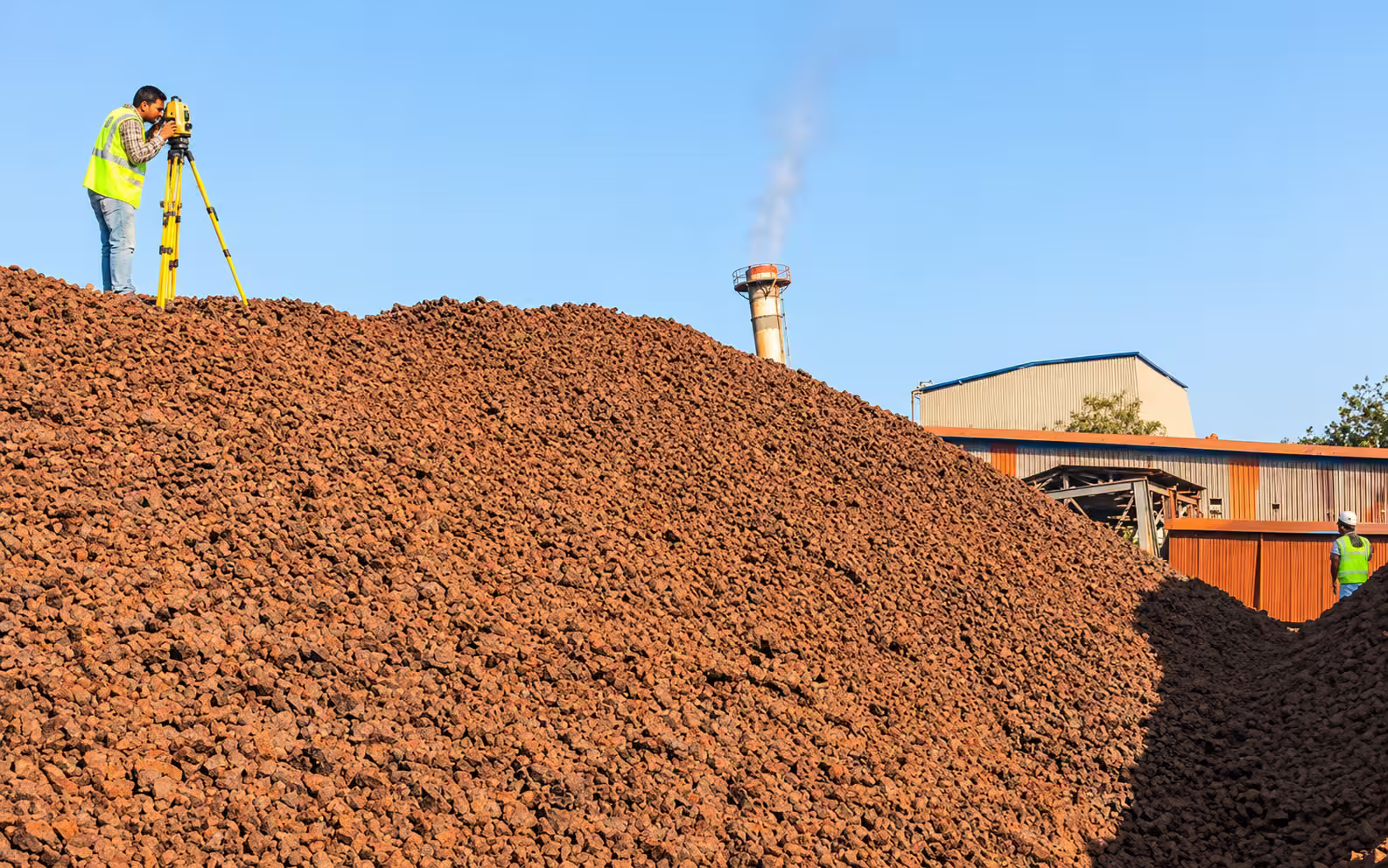
A stockpile’s volume is the space between its surface and the ground it sits on. Every method is a way of describing those two surfaces and finding the space between them.
Why volume matters
Plants and traders reconcile books against physical stock. A measured volume, converted to weight with the right density, shows whether records and reality agree.
Methods compared
- Estimation by shape: treat the pile as a cone or prism. Quick, but only rough for irregular piles.
- Total station survey: closely spaced points are measured over the surface and the volume computed in software. Suited to irregular and controlled piles.
- Drone or laser scanning: dense data over large areas, with ground control for accuracy.
Base surface and density
The base surface is the ground under the pile. If it is assumed flat but is not, volume is wrong. Density converts volume to weight; it changes with material, size, moisture and compaction, so it is measured, for example by the box method, and not assumed.
Worked example (illustrative numbers)
Suppose a conical pile has a base radius of 10 m and a height of 6 m on flat ground. Volume = ⅓ × π × r² × h = ⅓ × 3.1416 × 100 × 6 ≈ 628 m³. If the measured density were 0.85 t/m³ the weight would be about 534 t. These figures are only to show the arithmetic; a real pile is irregular and is measured by survey.
Common errors: wrong base surface, too few points on a changing surface, and using a book density instead of a measured one.